
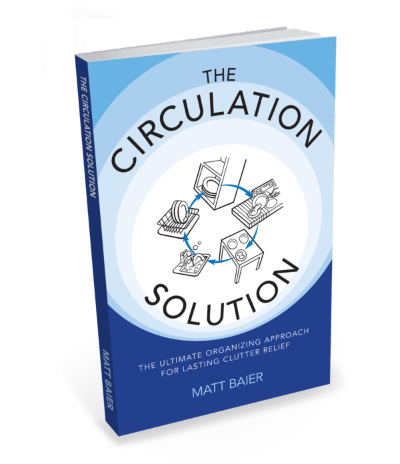
If you’ve worked with Matt Baier Organizing before, you may have picked up on some of our frequently used words and phrases- we have a lot of them! Some are more straightforward while others are more unique. While we certainly didn’t invent all of these, we’ve collected a useful dictionary. Using specific vocabulary is helpful for both our organizers and our clients. Each word and saying has a specific meaning that aligns with our organizing technique. Using consistent language helps to keep our organizers and our clients to work efficiently towards a clear, common goal. If you want to get familiar with a sample of our most commonly used terms, keep on reading!
Matt Baier Organizing Vocabulary
Remote storage
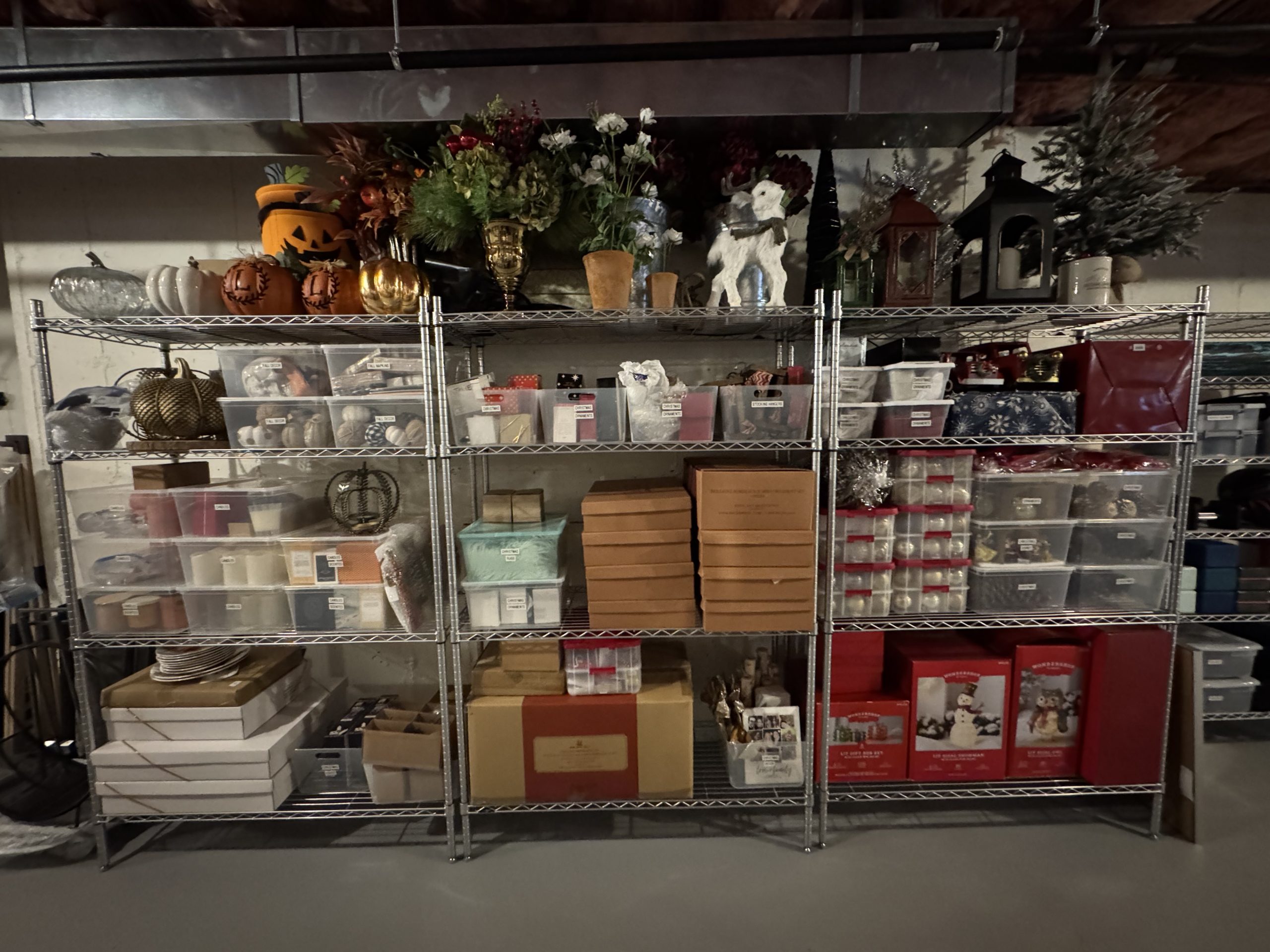
One of the best ways to free up living space is by storing less-frequently accessed items more remotely. For example, many clients like to hang onto their keepsakes – mementos from past trips, scrapbooks, old letters, family heirlooms, etc., but they don’t actually use or access these items very often. Therefore they can be stored in an area of the home that isn’t as easily accessible like an attic or basement. This is what we call remote storage.
Homeless categories
Most categories of things have obvious homes within the home, but some do not, these are your homeless categories. Examples include keepsakes, décor, gifts-to-give, ongoing projects and donations.
Exit zones
This refers to where all of your discards will end up. It’s important to identify exit zones before you get started so that every item has a clear direction and designated space to go to. Exit zones should be easily accessible via a clear path and easy to remove discards and donations to at the end of the day. Before you dive into the clutter, give some thought to where it’s going to go. If you’re decluttering your whole home, I recommend starting with the garage or other external location. You tend to find quick wins there and you can use the open space for discards and donations from the rest of the house. If you’re generating a lot of clutter, trucks can then easily back up to that spot and take it away.
Processing area
This is the area in which our team processes all of our client’s items. It should be an open space with clear paths to the exit zones. The processing area is important because we can’t always assess and categorize within the space that we will ultimately organize. For example, when organizing an attic we typically transfer the contents of the attic to a processing area in a more open, brightly lit space like a family room.
Review
Simple. The “review” stage of our organizing process follows the “categorize” stage. Once our team has categorized all of our client’s items, we bring them to our review table for our client to review and make a decision (keep, toss, donate, give-away, ask spouse, sell etc.)
Slow review
This is a home for those items that clients are not quite ready to make a decision on when they reach the review table. Oftentimes this includes paper or keepsakes. It may not be the best use of our client’s time with our team to go through piles of paperwork. To prevent the process from slowing down, we put these items into a designated and labeled “slow review” box for the client to review on their own time.
Running, Sitting, Sleeping and Dead Files
Running files are files that you want to make a point of acting on. They should be out where they demand action. Sitting Files are files you need to be able to find reliably. They require a user-friendly filing system at your finger tips. Sleeping Files are files you are keeping just in case. They are perhaps the most important stage to recognize because they can be stored remotely and free up a tremendous amount of space in your home office. Dead Files are files that have lost all value and can be recycled or shredded.
Donation Depot
A spot to collect all of your donations in a convenient location where you’ll remember to take it to be donated. A bin in the garage is a smart idea. Once the bin fills up it will be conveniently located by your car to take to your donation center of choice.
Matt Baier Organizing Phrases
Circulation prevents accumulation
The most important thing to create to keep the clutter from returning is a plan for movement in a series of manageable, reliable stages. We prefer to focus on a continuous flow of items rather than a single “a place for everything” system. By moving items through their lifecycle, you prevent them from piling up and becoming clutter.
Regret-free process
This means when in doubt don’t throw it out. If you feel like maybe you should let something go, but you’re just not ready, don’t! We know from experience that nothing slows the process down faster than regret. All we ask is that you clarify why you are keeping. Give us the right category and we’ll keep it with the others in that category. Now we can get back to the easier decisions and maintain that all important momentum.
Momentum trumps perfection
The regret-free process is a good example of momentum trumps perfection. It’s far more important to maintain a good momentum than to make the perfect keep-or-toss decision.
Prioritize to organize
This concept guides our entire process. Our team sorts our client’s items into categories, which reveals the volume of each category and makes decision-making easier. Then our clients can focus on the priority of what they gain from organizing rather than what they are discarding. Prioritization requires that the client assess the use and frequency of use of each category. Things that you use annually should be reduced and smaller. Someday/maybe items should go entirely. For example, you might want to hold on to large, empty bins for moving someday, but they’re seldom used otherwise and therefore can be stored remotely.
Context drives decisions
We always sort like things together before we review them, so you can create singular focus. It’s easier to assess relative value when you are looking at just shoes or just books or just office supplies, etc. You’ll toss those not-so-good shoes much faster when you see just how many good shoes you have.
Only two directions to go: Up or out
When organizing, items can only go in two directions: up or out. To create clear space, all items that clutter your floors and surfaces must go up (onto shelves or into cabinets, etc.) or out – discard, donate, sell, or relocate.
We make space, not judgements
Clearing a path forward is my life’s work and I have no space for being judgmental, but my clients are often very judgmental of themselves. The number one consult question I get is, “Is this the worst you’ve ever seen?” I also get, “What’s wrong with me? I’m overwhelmed. Am I hopeless?”
Showroom vs. stockroom
A showroom space is open, well-lit, inviting. There is a limited amount of inventory, mostly below eye level, and a lot of activity. Whereas, In the stockroom space it’s a different story. You worry less about what it looks like and you can take more advantage of vertical space. That way you can fit more in, but there is less activity.
Clarify Your Why
When you clarify your why – the specific reason that you want to declutter and get organized, then you give yourself a goal that pulls you forward. You have a reason not just to start, but to finish. That’s crucial because then the decluttering process becomes less about what you are giving up and more about what you are gaining.
Quantity dictates systems
Quantity control starts by establishing dedicated zones. These are areas in your home- could be a set of shelves, one shelf, or a closet- that limit you to one category. Leave a little room for growth, but try to stay within these well-established zones. Otherwise, one dedicated zone will start to spill into another and you end up where you started. You will know the structure size you need for dedicated by seeing the quantities you have in your Keep Zone.
Reveal, don’t conceal
This one is pretty simple. Visibility maximizes find-ability and if you’re easily able to find your items, you’re far less likely to purchase excess amounts you don’t need. This is why we love to containerize using clear bins.
This is only a small sample of our Matt Baier Organizing dictionary, but I hope that these words and phrases can help you to get organized and stay organized! If you choose to have our team help you with your organizing needs, you’re sure to hear more of our fun-ducational sayings!
Which of the above is your favorite saying?
Please Share With Your Community


Related Posts





Testimonials
What some of our clients are saying